#GIVEASHIT
ThankBack Thursday
Continuing our tradition of exhibiting gratitude one day of the week (I can assure you that we're grateful more often that once per week). We have SO much to be appreciative of, but in the interest of keeping this going weekly, we'll stick to two ThankBacks this week:
Continuing our tradition of exhibiting gratitude one day of the week (I can assure you that we're grateful more often that once per week). We have SO much to be appreciative of, but in the interest of keeping this going weekly, we'll stick to two ThankBacks this week:
Shelley True and Lianne Wand
Shelley and Lianne of TrueDotDesign are the best. Their marketing expertise is seemingly infinite and these women just get us. Shelley and Lianne have been so helpful in teaching us how to spread the word even more effectively. They are committed to helping us look as good as we feel (because we're worth it). We can't express how thankful we are that these two incredibly intelligent and talented individuals are willing to help us improve access to safe sanitation at schools that need it most!
Muk and Sunil Ghale
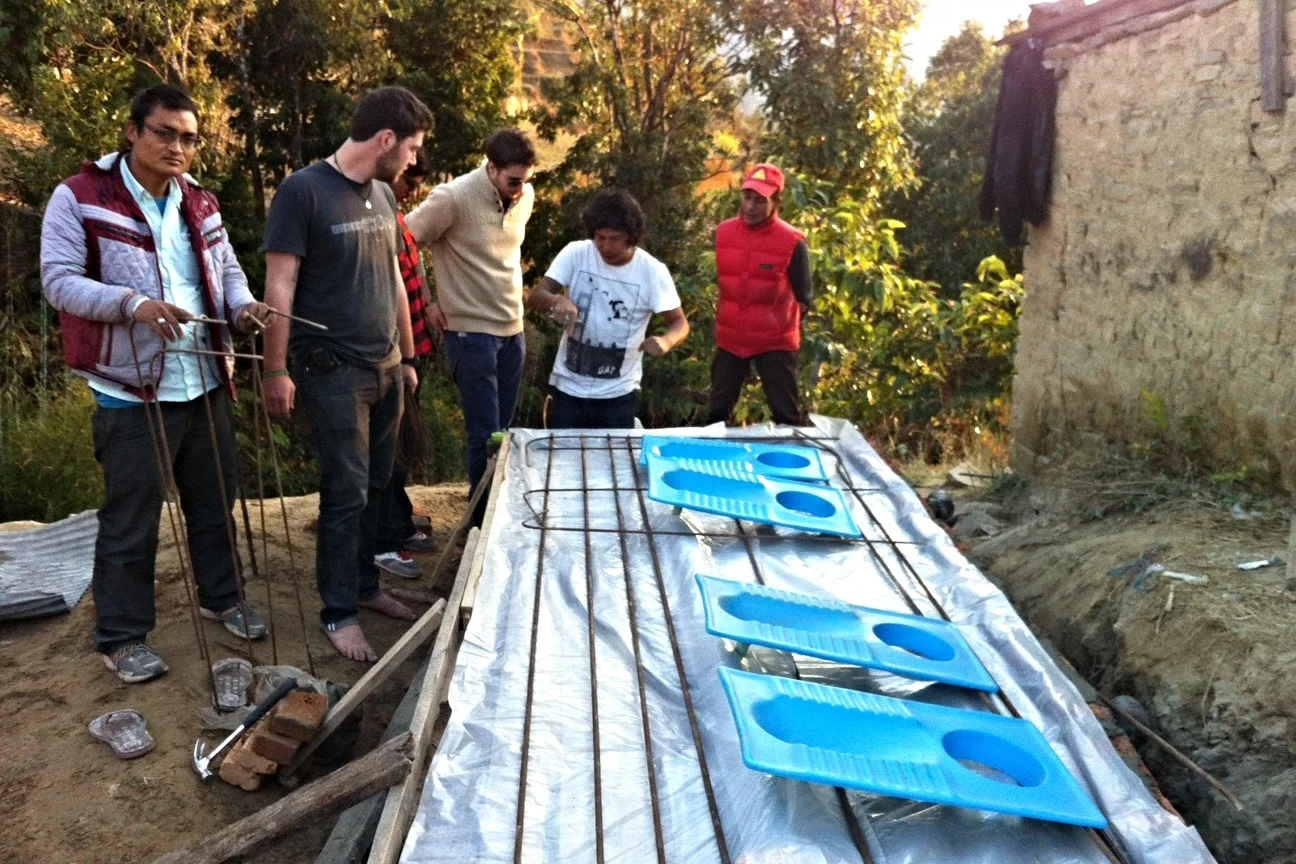
These brothers are the guys to know in the Kathmandu. Their rest-bar, Phat Kath (a high-quality Kathmandu pun) is one of Kathmandu's hidden treasures. Muk and Sunil were infinitely supportive of us during our time in Nepal in 2012/2013, and we can't wait to see them again in June. Driving out to our pilot project on the back of Muk's red Royal Enfield motorcycle, instead of taking the local bus for the millionth time was a welcome and exciting treat. Muk and Sunil helped us build our first toilet, and without Muk's extensive construction experience, we couldn't have been successful. Anyone thinking of traveling to Kathmandu would be foolish not to make Phat Kath one of their first stops, where Muk and Sunil can provide advice on anything from the best trekking routes to a trip to their BEAUTIFUL hometown of Manang.
How My Life Went to Shit (in a good way)
Running a nonprofit is hard, really hard. Nobody gets into this line of work because it's easy or pays well. For people like those on our team, we do this because we feel it's what we have to. The following is the story of how Manavta came to be, and why.
When Nabeel and I were living in Nepal, we saw things that boggled our minds. How can there be so much beauty in a place so rife with poverty and squalor? Diarrhea is something we knew to be mildly unpleasant, something we had only experienced after eating bad seafood or binging on lactose. We certainly did now know it to be something that kills 1.5 MILLION children each year (UNICEF, 2009). Together with pneumonia, the two are responsible for more than 40% of all child deaths around the world (according to the same UNICEF report). We saw women and girls marginalized to the point of forfeiting their educations: let me explain...
Running a nonprofit is hard, really hard. Nobody gets into this line of work because it's easy or pays well. For people like those on our team, we do this because we feel it's what we have to. The following is the story of how Manavta came to be and why:
When Nabeel and I were living in Nepal, we saw things that boggled our minds. How can there be so much beauty in a place so rife with poverty and squalor? Diarrhea is something we knew to be mildly unpleasant, something we had only experienced after eating bad seafood or binging on lactose. We certainly did not know it to be something that kills 1.5 MILLION children each year. Together with pneumonia, the two are responsible for more than 40% of all child deaths around the world (UNICEF, 2009). We saw women and girls marginalized to the point of forfeiting their educations: let me explain...
I was teaching english at a rural public government school called Mahindra Adarsh Mavi HSS, in a place called Imadol (ko Krishna Mandir). There are a quite a few brick factories in the area, and most of my students (classes 7-10) either worked at the factories or were domestic help in homes nearby. Most of them were sent to Kathmandu to study, their families being from villages far away where education is not at all accessible. On one of my days off, I was on a walk with one of my housemates Rob - talking about how the girls in my classes tended to miss school for a week every month. I was asking him what I had done wrong, when he dropped the M-bomb.
Menstruation.
First of all, I have never gotten my period (I think it has something to do with being a man) - so the thought had never crossed my simple mind. I finally caught on to the fact that these girls were stuck practicing Chhaupadi; a practice where Nepalese women are routinely forced to live in a shed for the duration that they're menstruating, as they're considered impure (Here's a Globe and Mail article about it). As written in that article, "The tradition was outlawed by Nepal's Supreme Court in 2005, but has been slow to change." I couldn't believe what I hadn't understood for over six weeks. I started talking to all of my Nepalese friends, asking what could be done. Overwhelmingly, they said the same thing: build toilets. So many rural schools in Nepal have no sanitation facilities, meaning that girls have no place to change the rags they use when menstruating. Going to school for the day and not changing these rags leads to disease and infection. For many girls, school isn't worth the risk. When toilets are present, feminine hygiene products can be changed and girls can reclaim access to education.
This led to our pilot project. Fast forward two years, and here we are. Our mission is simple: to empower leaders to bring safe sanitation to their communities through education. Safe sanitation benefits everyone, while enabling women and girls to reclaim access to their education.
In the coming weeks, we'll post about our approach to community and school-led sanitation, cultural taboos and general nonprofit best practices. But honestly, all of that would mean a lot less if you didn't know the story of how me and my team's lives went to shit.