
#GIVEASHIT
Ranting about Gender
News from the subcontinent last week focused on the rat poison found in drugs administered to women following a group sterilization procedure in Chhattisgarh, India. While concern has rightfully been raised regarding the quality of pharmaceuticals in India, another issue within this story seems to have raised few eyebrows – why are the women being sterilized?...
The Brief
News from the subcontinent this week focused on rat poison found in drugs administered to women following a group sterilization procedure in Chhattisgarh, India. While concern has rightfully been raised regarding the quality of pharmaceuticals in India, another issue within this story seems to have raised few eyebrows – why are these women being sterilized in the first place?
Sterilization procedures performed on women (called tubal ligations) are more invasive and riskier than those performed on men (vasectomies), but most news coverage has simply noted that ‘cultural taboos’ make the procedure for women more common in India. They fail to engage with the fact that population control in India comes in the form of enacting control over women’s bodies rather than through other (safer and less invasive) means.
Gender inequalities on the subcontinent are not news. In 2012, India ranked 57th out of 86 countries on the Social Institutions and Gender Index. Nepal ranks better than its neighbors on the Index, but discrimination persists. According to Nepal’s 2013 MDG report, only 57.4% of females over 5 are literate compared with 75.1% of males. Recent increases in female school attendance may improve this statistic in the future.
Bringing it home
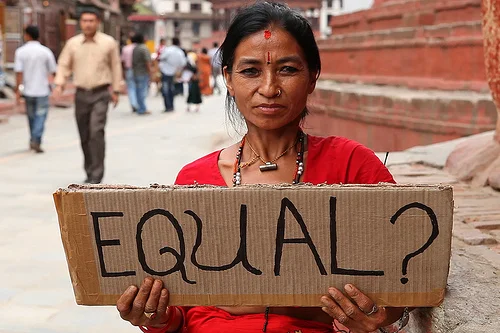
Of course, gender inequality is not just an issue in the developing world. Women face discrimination in the rich world, too (see, for example, the recent news on a group teaching lessons in enacting violence on women). Fighting pervasive prejudice globally requires changes in attitudes and increased opportunities for marginalized genders to voice their perspectives and needs.
With indications that lack of toilets in schools may impact school attendance in Nepal, particularly for girls post-puberty, toilet-building takes on one of the many pieces required for continuing to improve gender equity. And that’s why we #giveashit.
The Crapper
Happy World Toilet Day!
Poop is one of my favourite topics of conversation, and the reason why today is such a special day. Happy World Toilet Day – lets celebrate one of our most important inventions...
Happy World Toilet Day!
Poop is one of my favourite topics of conversation, and the reason why today is such a special day. Happy World Toilet Day – lets celebrate one of our most important inventions.
Know your Toilet
Improved sanitation is the reason why most of our species no longer lives with brutal dieseases like cholera, dysentery and typhus — not to mention the bubonic plague. Sanitation itself dates back as far as the 1800 B.C.E. when the Minoans from the Island of Crete used underground clay pipes for sanitation and water supply. Almost 1500 years later, the Romans and Egyptians followed suit and introduced the concept of indoor pooping, with some incredibly designed toilets truly fit for a king!
Our modern flushing toilet was formally developed by Alexander Cummings in 1775. Contrary to popular belief, Sir Thomas Crapper did not invent the flush toilet. He was, however, a game changer in the industry with 9 patents to his name and serving the crown as their plumber. Legend has it that Queen Elizabeth I was too embarrassed to use the flush toilet since the noise would inform the palace of her bowel movements.
Over 200 years later, the world has made some astounding technological advances and yet the toilet remains relatively unchanged. A single flush of the toilet uses about 3.5 gallons of water. That puts tremendous strain on limited water resources (when billions of people are flushing toilets daily).
Innovation is Key
As we speak, our incredible team of engineers is hard at work developing a dry toilet system that produces agricultural inputs with a technically efficient structure. For the 2.5 billion that are still forced to defecate in the open, we must introduce toilets that are operable without electricity, running water or septic systems. Many organizations spend a lot of money on septic tanks and complicated systems that our engineers can't disagree with more. Check out more about these designs via the Reinvent the Toilet Fair.
Today, while you are sitting on your toilet doing your thing – please remember how truly fortunate we are, think about those who aren't, and for god's sake use febreze after you cut the cheese.